Let Your Fingers Do the Indexing: How the Yellow Pages Alphabetized America Before the Algorithm
Photo: Walter Baxter , CC BY-SA 2.0, via Wikimedia Commons
Before there was a search bar, there was a book on the porch. It was thick, free, and organized by a principle so obvious that nobody thought to question it: the alphabet. The Yellow Pages were not just a directory. They were America’s first mass-market search engine, and they trained several generations to look for the world in alphabetical order.
The Porch Drop
The distribution model was elegantly invasive. Phone companies dropped the books at homes and businesses, often door-to-door, often whether you wanted them or not. The Yellow Pages were the commercial half of the phone book, distinguished by the yellow paper and the promise that you could find a plumber, a pet store, or a paralegal without asking a neighbor. The slogan 'Let your fingers do the walking' did not just sell advertising. It described a new physical gesture: the index finger sliding down a column of names until it landed on the right category.
In the postwar decades, the book became a fixture of American domestic life. It lived under the kitchen phone, on top of the fridge, or in the drawer where the takeout menus went to die. It was updated annually, which meant it was always slightly wrong. It was free, which meant it was everywhere. And it was alphabetical, which meant it was fair in the way that a dictionary is fair: it did not care who you were, only what you were called.
The Original Query Syntax
The Yellow Pages taught Americans a specific kind of search literacy. You did not type a question. You guessed a category. If you wanted a lawyer, you looked under 'Attorneys.' If you wanted a lawyer who specialized in something, you looked under a subheading that might be 'Attorneys—Bankruptcy' or 'Attorneys—Family Law.' If you did not know the category, you looked at the cross-references. The book was a taxonomy with ads.
'It was a controlled vocabulary,' says Ruth Ellison, an information historian who has written about print directories. 'The alphabet was the interface. The categories were the metadata. The ads were the sponsored results.' Ellison says the system was surprisingly robust. 'People complain about algorithmic bias now, but the Yellow Pages had a different bias: whoever paid for the biggest display ad got the most attention. The alphabet was neutral. The page was not.'
The display ads were where the book became visual. A half-page ad for a roofing company might feature a drawing of a house, a phone number, and a font that looked like it had been rescued from a hardware store. The smaller listings were pure utility: name, address, phone number, maybe a tagline. The result was a design language that was loud, local, and completely unpretentious. It was not trying to be beautiful. It was trying to be findable.
The Font That Wouldn’t Die
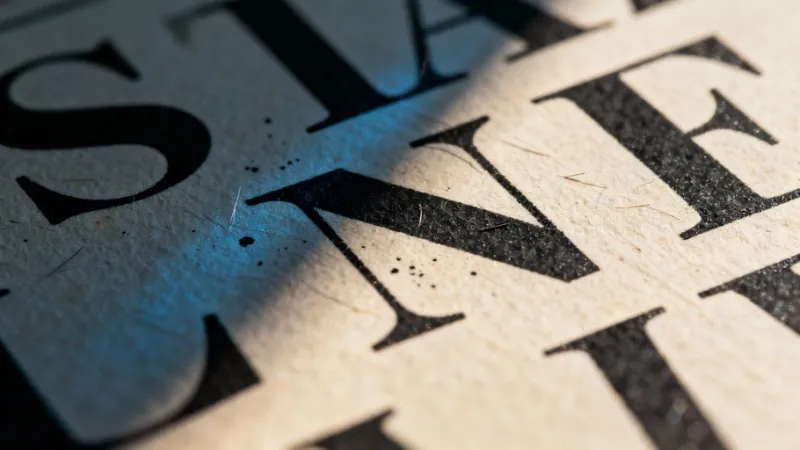
Type designers have a soft spot for phone books because they are a master class in legibility under pressure. The pages were thin, the ink was cheap, and the columns were narrow. The type had to work at a small size, in bad light, for people in a hurry. Bell Gothic, designed for AT&T in the 1930s, became a kind of ancestor to the genre: compact, sturdy, and almost aggressively readable. Later directories used a range of condensed sans serifs, all built for the same job.
'Phone-book type is the opposite of a display face,' says typographer Neil Barrow. 'It is a service face. It is there to disappear into the information.' Barrow says the style has had a strange afterlife. 'You see it in retro menus, in band posters, in anything that wants to feel like a small business that has been around since 1978. It is shorthand for unglamorous competence.'
The Slow Unindexing
The Yellow Pages did not die because the alphabet stopped working. They died because the business model changed. The internet made search cheaper, faster, and more measurable. Phone companies spun off directories, then sold them, then stopped printing them. In many places, the books became opt-in. In others, they simply vanished. By the 2010s, the porch drop was a memory, and the book under the kitchen phone was a piece of nostalgia.
In 2026, the Yellow Pages exist mostly as a brand, a website, and a punchline. But the alphabet they used is still with us. Every time you sort a playlist, scan a contact list, or type a name into a search field, you are using a descendant of the same idea: put the world in order, then let the user find it. The difference is that the order is now invisible. The algorithm decides what comes first. The phone book told you.
That is what we lost, and what we maybe romanticize. The Yellow Pages were inefficient, wasteful, and often wrong. They were also public, predictable, and browsable in a way that a feed is not. You could open a page and see your whole town in alphabetical order. You could find a business you did not know you needed. You could let your fingers do the walking. In 2026, we let the algorithm do the walking. It gets us there faster. It just does not let us see the street.