😂 Is a Complete Sentence: The Case For, Against, and Completely Beside the Alphabet
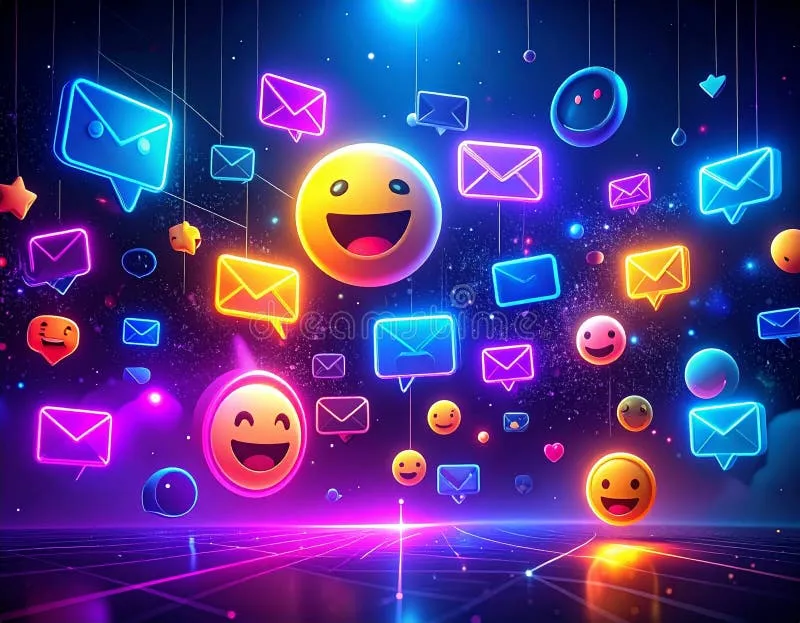
Photo: emoji symbols communication digital language colorful screen, via thumbs.dreamstime.com
Let's establish the stakes immediately: approximately 10 billion emojis are sent every single day. The entire written output of the Library of Congress — every book, every document, every letter — contains roughly 10 terabytes of text. Americans send that much emoji data before lunch on a Tuesday. The alphabet, which has been running unopposed since roughly the Phoenicians got ambitious, suddenly has competition. Weird, yellow-faced, occasionally ambiguous competition.
The question is not whether emojis matter. They clearly do. The question — the one that semioticians are having very animated arguments about at conferences that most people will never attend — is what kind of thing they are. Are they a new alphabet? A replacement alphabet? A completely different category of communication that makes the word "alphabet" feel quaint and limited? Or, as one particularly exhausted linguist put it to this writer, "just pictures that teenagers use to avoid saying anything specific?"
All of the above, probably. Welcome to the future. It has a lot of eggplants in it.
The Alphabet's Actually Pretty Weird Too, If You Think About It
Before we declare emojis the villain or the savior of written communication, it's worth remembering that the alphabet was always a bizarre, arbitrary system that someone at some point decided to treat as inevitable. The letter 'A' does not look like the sound it makes. The letter 'Q' is essentially a hostage situation involving 'U.' English spelling, in particular, is less a system and more a crime scene where several different languages had an argument and nobody cleaned up afterward.
Dr. Simone Wexler, a semiotician at Columbia University who has spent the last six years studying emoji as a communication system, makes this point with considerable enthusiasm. "We act like the alphabet is the natural, logical way to represent language, and everything else is a deviation," she says. "But pictographic writing systems predate alphabets by thousands of years. Emoji isn't regression. If anything, it's a really old idea running on new hardware."
The Unicode Consortium — the nonprofit organization that decides which emojis get to exist, a job title that would have been incomprehensible as recently as 2005 — now maintains a vocabulary of over 3,600 approved emoji characters. For context, the Oxford English Dictionary contains around 170,000 words. Emojis are not winning the quantity race. But quantity, as any good designer will tell you, is not the point.
Gen Z Didn't Break Language. They Upgraded the Firmware.
Talk to anyone under twenty-five about how they use emoji and you will immediately realize that what's happening is not simplification. It is, if anything, significantly more complicated than anything the alphabet is doing.
Jasmine Ochoa, a 22-year-old graphic design student in Los Angeles, communicates with her friend group almost entirely through what she calls "emoji syntax" — sequences of symbols that carry nuanced emotional and contextual meaning that would require entire paragraphs to express in words. "The 🙃 emoji doesn't mean 'I'm smiling,'" she explains, with the patient tone of someone who has explained this before. "It means 'I am holding it together by a thread and we both know it.' There's no word for that."
She's right. There isn't. And this is where the conversation gets genuinely interesting rather than just generationally anxious. Emoji sequences have developed grammatical structures, contextual rules, and layers of irony that shift over time and across communities. The 💀 emoji means "I am dead" which means "I am laughing." The 🧢 emoji means "lie" in a usage that emerged from Black American slang. These are not pictograms with fixed meanings. They are a living, evolving, community-maintained language.
"That's what all languages do," says Dr. Wexler. "They're maintained by communities. They evolve. They pick up new meanings and shed old ones. The alphabet isn't different — it just moves slower."
The Designers Building the Next Visual Language
If emoji are a parallel alphabet, someone has to design them. And the people doing that design work are increasingly aware that they are making decisions with real linguistic consequences.
Yvette Huang, a visual communication designer based in San Francisco who has consulted for several major tech platforms on emoji design and accessibility, describes her work as "writing letters for a language that doesn't have a dictionary yet." Every design choice — the angle of an eye, the color of a hand, the specific shade of yellow — carries meaning that will be interpreted, misinterpreted, and reinterpreted by billions of people across wildly different cultural contexts.
"There's no neutral emoji," she says. "Every choice is a statement. When the original emoji set had only one skin tone, that was a statement. When we added profession emojis, how we gendered them was a statement. We're writing an alphabet, and alphabets have politics."
This is, it turns out, also true of the original alphabet. It was just true a long time ago, and everyone forgot.
The Verdict (Which Is Not a Verdict)
Here is the honest answer: emoji did not replace the alphabet. The alphabet is fine. This article is written in it, and you are reading it, and everything is okay. But emoji did do something the alphabet has been unable to do for centuries — they acknowledged that written communication has always been missing something. Tone. Affect. The physical, embodied expressiveness of talking to another human face-to-face.
The alphabet gave us precision. Emoji gave us the part that was always leaking out the sides.
At ABCDF∞, we've always maintained that the alphabet is less a finished system and more an ongoing argument. Emoji just pulled up a chair. And honestly? The 🪑 was always there.