One Letter, Infinite Work: 10 American Artists Who Bet Everything on a Single Glyph
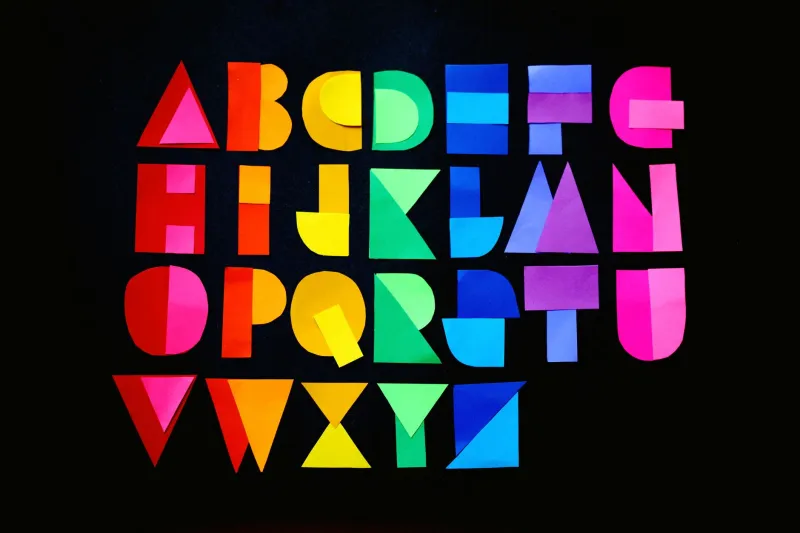
The alphabet has twenty-six letters. Most of us use all of them, bouncing between vowels and consonants like a pinball machine, never stopping long enough to really look at any single one. But a particular breed of American artist has made a different choice — the kind of choice that probably alarmed their MFA advisors and delighted everyone else. They picked one letter. Just one. And then they went absolutely, gloriously all-in.
This is their story. All ten of them. Buckle up.
1. Tauba Auerbach — The Letter That Became a Universe
San Francisco-born, New York-based Tauba Auerbach has spent a career interrogating the visual logic of language, but their deepest obsession has always been with the letter I — specifically the way a single vertical stroke can represent both the self and a mathematical concept and a phoneme and a graphic mark, all simultaneously. Auerbach's paintings, which layer text and geometry until meaning becomes texture, return again and again to the vertical line as a unit of meaning. When asked about it in interviews, they tend to give answers that are themselves shaped like the letter I: tall, narrow, and somehow saying more than seems possible.
2. Neon Artist Grimanesa Amorós — Bending Light Into Letters
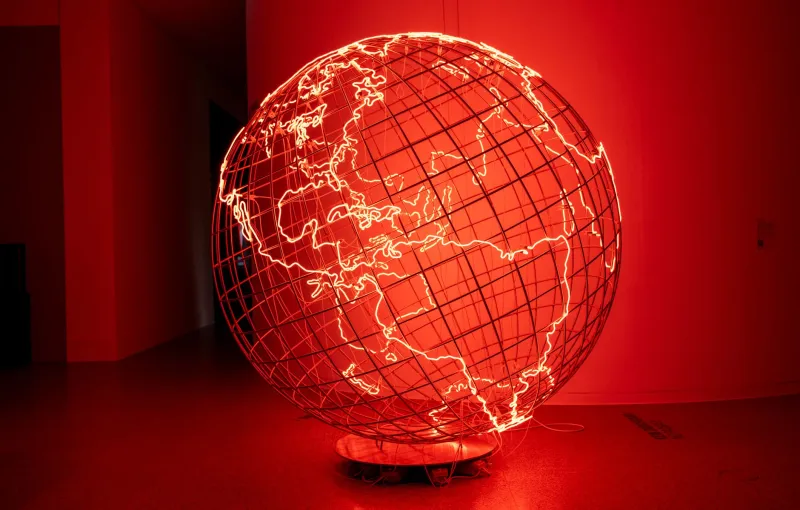
Peruvian-American artist Grimanesa Amorós is best known for large-scale light installations that transform public spaces into glowing environments. But spend enough time with her work and you'll notice a recurring formal obsession with the letter O — the circle, the loop, the self-completing curve. Her installations in New York and across the US return compulsively to forms that close in on themselves, that have no beginning and no end. The O isn't just a letter in her vocabulary. It's a cosmology. It's the shape of a face looking up at light. It's everything that returns to where it started and is somehow different for the journey.
3. Tattoo Artist Dr. Woo — The Letter W and the Art of the Fine Line
Los Angeles tattoo artist Dr. Woo (Brian Woo) built one of the most recognizable bodies of work in contemporary tattooing on a style so fine, so precise, that it barely seems to touch skin. And while he'd probably deny having a letter fixation, his aesthetic is unmistakably shaped by the W — the double V, the zigzag, the form that goes down and up and down and up again before resolving. His linework, his signature compositions, his actual name: the W is everywhere. His Instagram following exceeds 1.4 million people who watch him turn skin into something that looks like a page from a very beautiful, very small book.
4. Experimental Musician Matana Roberts — Composing in the Key of C
Chicago-born saxophonist and composer Matana Roberts has been working on a sprawling, multi-volume project called Coin Coin for over a decade — a suite of compositions that process Black American history through improvisation, field recordings, and spoken word. The letter C runs through it all: Coin Coin, yes, but also the key of C, which Roberts returns to as a kind of home base, a tonal anchor for music that is otherwise deliberately, productively unmoored. In interviews, Roberts has described C as "the beginning of something that doesn't have an end" — which, if you've heard the records, is exactly right.
5. Typeface Designer Tobias Frere-Jones — The Letter G and a Life's Work
New York typographer Tobias Frere-Jones, co-creator of the Gotham typeface (yes, that Gotham, the one on Barack Obama's Hope poster, the one that became the visual voice of an entire cultural moment), has spoken publicly about his long-standing obsession with the letter G. The G is, by most typographic accounts, the hardest letter to draw. It has a spur, a crossbar, an ear — it's basically a small architectural project crammed into a single glyph. Frere-Jones has said that he judges a typeface by its G first, because if a designer can handle the G, they can handle anything. His entire career is, in a sense, an extended argument with that one letter.
6. Visual Artist Mel Bochner — The Letter That Became a Painting
Pittsburgh-born conceptual artist Mel Bochner has spent decades making paintings that are also arguments — canvases covered in words that comment on themselves, on value, on meaning, on the gap between what language promises and what it delivers. His recurring engagement with the letter B — his initial, yes, but also the second letter, the one that always comes after the beginning — gives his work a quality of perpetual almost-arrival. His Blah Blah Blah series, in which the word "blah" is repeated in increasingly frantic configurations, is essentially a love letter to the B's capacity to mean nothing and everything simultaneously.
7. Street Artist Swoon — The Letter S as a Signature and a Philosophy
Brooklyn-based street artist Swoon (Caledonia Curry) has been pasting hand-cut prints of human figures onto urban surfaces since the late 1990s, and her visual signature — the sinuous, flowing line that defines her figures — is unmistakably S-shaped. The S curves, it reverses, it refuses to go in a straight line. It's the most dynamic letter in the Roman alphabet, and Swoon's entire aesthetic embodies it: her work flows around corners, adapts to surfaces, moves like water through a city that wasn't designed to accommodate beauty. The S doesn't demand space. It finds it.
8. Performance Artist Reza Abdoh — The Letter A and the Act of Beginning
The late Iranian-American theater director Reza Abdoh, who created some of the most confrontational performance work in American theater history before his death in 1995, was preoccupied throughout his career with beginnings — with the act of starting, with the violence and possibility of the first gesture. The letter A, the beginning of everything, the first sound a mouth makes when it opens without intention, runs through his work like a current. His productions began with explosions of energy that felt like the letter A made physical: angular, aggressive, impossible to ignore, and pointing, always, toward something that came after.
9. Graphic Designer Paula Scher — The Letter P and the Art of the Poster
New York design legend Paula Scher, whose work for the Public Theater redefined what an institutional visual identity could look like, has a well-documented love for the letter P. The Public. Pentagram (her firm). Paula. The P is everywhere in her professional life, and it shows up formally in her design work as a shape that balances weight and openness — a vertical stroke with a bowl that holds space without closing it off. Scher's typography is famously bold, declarative, and slightly overwhelming in the best possible way. It is, in other words, exactly what a well-designed P should be.
10. Neon Sculptor Chryssa — The Letter That Started It All
Greek-American sculptor Chryssa, who pioneered the use of neon and electric signs as fine art materials in the 1960s, built her most significant American work — The Gates to Times Square — around the letter A. Not symbolically. Literally. The piece is constructed from repeated, fragmented, glowing A-shapes that reference the commercial signage of midtown Manhattan while transforming it into something meditative and strange. Chryssa understood, decades before the internet made it obvious, that letters are not just language — they are light, they are architecture, they are the physical infrastructure through which meaning moves through the world.
What Obsession Actually Looks Like
If there's a throughline in all of this — and there is, we're a website, we're required to have one — it's that monomaniacal creative focus isn't a limitation. It's a methodology. Every artist on this list made themselves smaller in order to go deeper, and what they found at the bottom of that single letter was not a dead end but an infinite corridor.
That's the thing about letters. They're small. They're just shapes. They're arbitrary agreements between people who needed to write things down. And yet you can spend an entire career inside one of them and never hit a wall.
At ABCDF∞, we skipped an E and kept going all the way to infinity. These artists skipped twenty-five letters and found the same thing.
The loop goes on. The work continues. The letter, whichever one you choose, is always bigger on the inside.