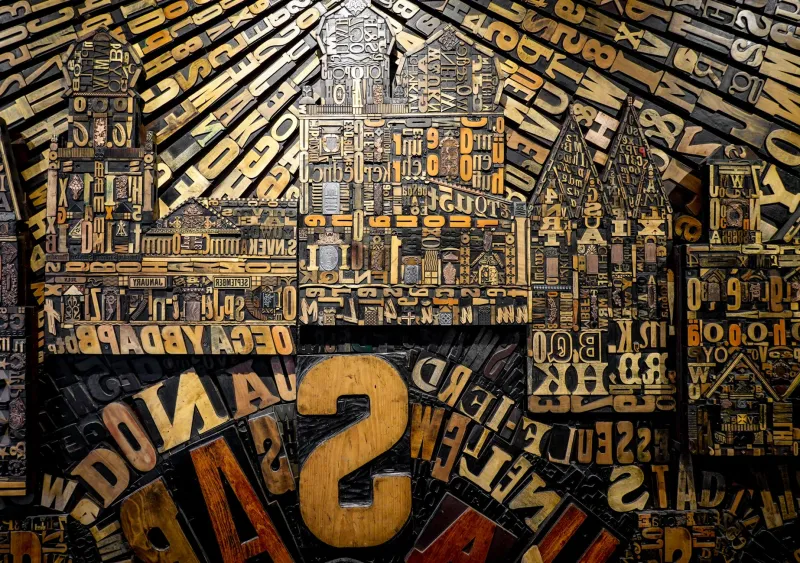
Kill the Alphabet: The Artists Building New Languages From Absolute Scratch
The name of this website contains a deliberate gap. ABCDF∞ skips E. It trails off into infinity. That's not a typo—it's a thesis. Letters, as we've always used them, are inherited furniture. Most of us never rearrange it. But a small, loud, beautifully weird community of American creators is hauling the whole alphabet out to the curb and building something stranger, more personal, and arguably more honest in its place.
We found some of them. We asked them questions. Their answers made us question everything, including whether this article should have been written in symbols we just made up.
The Cage You Never Noticed
Here's the uncomfortable premise: the alphabet is a technology. Like all technologies, it was built by specific people, in a specific place, for specific purposes. The Phoenicians didn't consult the universe when they started scratching consonants into clay. The Romans didn't receive the letter A from a higher power—they borrowed it, modified it, and eventually exported it across the world with the assistance of armies.
What gets lost in a system that was never designed for your voice, your body, your experience? That's the question driving a loose, ungovernable movement of American artists who are answering it the most direct way possible: by making new letters.
"The Roman alphabet is incredibly efficient at certain things," says Dominique Farrell, a Brooklyn-based zine maker whose self-published works use a constructed script she calls Vorrish. "It's terrible at others. There are feelings I have that I cannot transliterate into A through Z without losing something essential. So I built a system that could hold them."
Farrell's Vorrish script—developed over seven years of obsessive iteration in sketchbooks, on Post-it notes, and eventually in a series of limited-edition zines sold at art fairs across the Northeast—looks, at first glance, like someone doodled during a very long lecture on ancient Sumerian. On second glance, it looks like a language. Because it is.
Tattoo as Lexicon
In Phoenix, Arizona, a tattoo artist who goes by the name Codec (legal name withheld by request, which felt appropriately cryptic) has spent the last decade developing a visual system they describe as "post-phonetic." It doesn't represent sounds. It represents states.
"Standard writing systems are built around speech," Codec explains, sketching symbols in the air with a finger while we speak over video call. "Mine is built around sensation. There's a symbol for the specific feeling of remembering something you're not sure actually happened. There's one for the moment just before you cry but after you've decided not to. The alphabet has nothing for those."
Codec's clients—many of them queer, neurodivergent, or otherwise navigating identity categories that mainstream culture handles clumsily—commission permanent inscriptions in this system. The tattoos are meaningful only to those who know the language, which currently numbers around 300 people who have received either a tattoo or a hand-drawn lexicon card.
"It's the most intimate art project I've ever been part of," Codec says. "These people are carrying a language on their skin that most of the world can't read. That's not secrecy. That's sovereignty."
Digital Glyphs and the Post-Unicode Frontier
If you think inventing a new alphabet is purely an analog pursuit, meet Yael Okonkwo, a computational designer based in Austin whose project Glyphset/Zero has been quietly accumulating followers in design and tech communities for three years.
Okonkwo's system began as a response to a frustration: Unicode, the international standard that governs which symbols computers can display, is vast but politically shaped. Certain scripts are underrepresented. Certain communities wait years for their writing systems to be formally recognized and digitally supported. Okonkwo's response was to build a complete symbolic system outside Unicode entirely—one that exists only as downloadable font files shared via her website and a Discord server with 4,000 members.
"I'm not trying to replace Unicode," she clarifies. "I'm trying to demonstrate that the gatekeeping of symbolic systems is a political act. Who decides which glyphs are 'real'? Who decides which language deserves a keyboard? I decided to opt out of that conversation and just build."
Glyphset/Zero has 847 symbols and counting. It has no phonetic correlate—it's purely semantic and visual. Okonkwo releases new glyphs in batches, each accompanied by a short essay explaining the concept the symbol encodes. Recent additions include a glyph for "the specific loneliness of a city at 3 a.m.," one for "inherited shame," and one that Okonkwo describes simply as "the shape of an unanswered question."
Her Discord community uses the system to communicate in ways that feel, members report, both ancient and completely new.
The Linguist Who Went Off-Script
Not everyone building new symbolic systems is coming from an art background. Dr. Marcus Thibodeau, a linguist at a small liberal arts college in Vermont, has spent fifteen years studying constructed languages—conlangs, in the community's preferred shorthand—and recently began developing what he calls a "distributed alphabet": a system in which the meaning of each symbol shifts depending on what surrounds it.
"The Roman alphabet is fundamentally democratic in a very specific way," Thibodeau says. "Each letter has one job. A is A. But human meaning-making doesn't work like that. Context changes everything. I wanted a writing system that encoded that instability directly."
His system, which he has not yet named ("naming it would fix it too early"), has been presented at two academic conferences and received responses ranging from fascinated to deeply skeptical. He considers both reactions equally valuable.
"If nobody thinks you've gone too far, you haven't gone far enough," he says, with the serene confidence of someone who has clearly had this argument before.
Why Now? Why Here?
It's worth asking why this particular moment in American culture is producing so many people who want to torch the alphabet and build something new on the ashes. The answers, when you ask the creators themselves, are varied but share a common current.
Farrell thinks it's about legibility—not the visual kind, but the social kind. "A lot of people feel like the existing systems, linguistic and otherwise, weren't built to make them legible. Building your own system is a way of insisting on your own existence."
Codec frames it in terms of ownership. "We're in this moment where people are questioning every inherited structure. The alphabet is an inherited structure. Why should it be exempt?"
Okonkwo is more pragmatic. "The tools exist now. You can design a font on your laptop in an afternoon. You can distribute it globally for free. The barrier to building a new visual language has never been lower. Of course people are doing it."
The Infinite Remainder
At ABCDF∞, we skipped E. We ran to infinity. The domain name is a joke about the arbitrary nature of the systems we inherit—but like all good jokes, it has a serious point buried inside it.
The alphabet is not the ceiling. It is the floor. And an increasing number of American artists are discovering that the most interesting work happens when you stop treating the floor like a fixed architectural feature and start asking whether you could build something entirely different underneath it.
The symbols don't exist yet. That's the whole point.
Somebody has to make them.