One Letter at a Time: The Stubborn Humans Still Spelling Out America on a Ladder
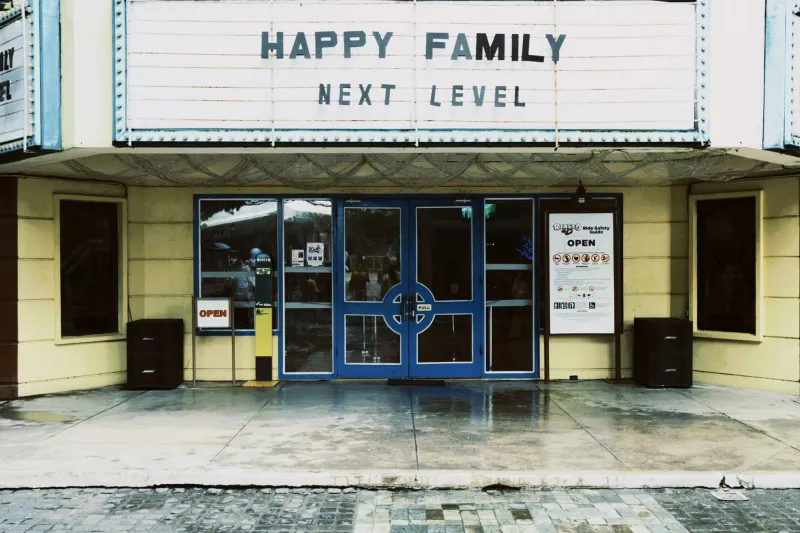
There is a particular kind of sentence that can only exist in the physical world. Not on a screen. Not in a push notification. Not auto-generated by some algorithm that has consumed the entire internet and emerged, blinking, to suggest you try the new Spicy Crunch Wrap. We're talking about the marquee sentence — the one assembled, letter by letter, by a human being balancing on a six-foot ladder in a parking lot while a light drizzle starts up and someone driving past honks for no clear reason.
This is not a lost art. Not yet. But it is, without question, a shrinking one.
The Alphabet as Physical Object
Let's start with the letters themselves, because at ABCDF∞ we are constitutionally obligated to care about letters more than most people. The plastic characters used in classic marquee signs — typically two to four inches tall, white or black, slotted into a track — are among the most democratically available typographic tools in American history. They don't require a design degree. They don't require software. They require a bucket, a pole with a hook on the end, and someone willing to do the math on how many letters fit before the sign cuts them off mid-word.
That math, by the way, is harder than it looks. Ask anyone who has tried to fit "WEDNESDAY NIGHT BINGO BRING A CASSEROLE" onto a sign with forty-two available slots per row and you will understand immediately why abbreviation is an art form.
The letters themselves get lost. They get dropped into gutters. They blow away in a strong wind. Every marquee operator in America has a story about the missing lowercase 'i' or the 'W' that was being used upside down as an 'M' until someone finally noticed. There is an entire shadow economy of replacement letters, sourced from hardware stores, other defunct signs, and occasionally the internet, where you can buy a bag of fifty assorted plastic letters for about twelve dollars and feel, briefly, like a very niche kind of millionaire.
The People on the Ladders
In Macon, Georgia, a woman named Deloris has been changing the marquee at her family's diner every Monday morning since 1987. She has a spiral notebook where she drafts the week's message in advance, crossing out options that are too long, too obscure, or "too smart for a Monday." Her current record for most compliments received on a single sign: a message that read, simply, EAT HERE OR WE'LL BOTH STARVE. She received seventeen compliments, two photos shared on Facebook by strangers, and one letter of appreciation from a woman who said it made her cry, which Deloris found "a little much, honestly."
In rural Ohio, a church deacon named Phil handles the sign every Saturday evening so it's ready for Sunday. He treats it like a sermon in miniature — something pithy, something warm, occasionally something that makes the congregation groan in the parking lot before they've even walked inside. He says the groaning is the goal. "If they're groaning, they read it. If they read it, they thought about it. That's more than most sermons get."
In Spokane, Washington, a second-run movie theater still maintains a classic backlit marquee, and the guy who changes it — a twenty-six-year-old film school dropout named Marcus — treats each week's message like a typographic puzzle. He photographs every configuration before committing to it. He has a folder on his phone with 340 marquee photos. He is aware this is a lot.
What the Digital Screen Cannot Do
The argument for digital marquees is obvious and not worth pretending otherwise. They're faster. They're weatherproof. You can change them from your phone while sitting inside eating the meatloaf special. They don't lose their 'Q's.
But here is what they cannot do: they cannot be watched being built.
This is the strange, specific intimacy of the hand-changed marquee that nobody talks about because it sounds slightly too philosophical for a Tuesday afternoon. When you drive past a marquee mid-change — letters half in place, the message still incomplete, a person on a ladder squinting at their notebook — you are witnessing language in the act of becoming. You are seeing a sentence that does not yet exist, held in suspension between intention and completion. It is, if you want to get extremely ABCDF∞ about it, the moment when the alphabet is most itself: pure potential, unresolved, mid-thought.
A digital screen has no such moment. It switches. It updates. It is finished before you notice it started.
The Pun as Community Service
It would be dishonest to write about marquee culture without spending real time on the puns, because the pun is the dominant literary mode of the American roadside sign and it deserves its flowers.
The marquee pun is a distinct subspecies. It must work at thirty-five miles per hour. It must require no context. It must land in the half-second a driver has before the sign is behind them and the road demands their attention again. This is an extraordinarily constrained creative form, and the people who are good at it — the Delorises, the Phils, the Marcuses — are genuinely skilled in a way that resists easy mockery.
A church in Tennessee once posted: FORBIDDEN FRUIT CREATES MANY JAMS. A diner in New Mexico ran: OUR WIFI IS TERRIBLE BUT OUR PIE IS GREAT. A theater in Vermont, during a particularly brutal winter, offered simply: STILL OPEN. BARELY. These are not high literature. They are also not nothing. They are small, handmade acts of communication between a building and the people who pass it every day, and there is a kind of municipal tenderness in them that no algorithm has yet learned to replicate.
What Gets Lost in the Update
When a marquee goes digital, the sign doesn't disappear. The building is still there. Messages still appear. But something in the relationship between the sign and its community quietly changes. The message is no longer a product of someone's Saturday afternoon and a bucket of plastic letters. It is a file, uploaded. It is content, scheduled. It has been optimized, possibly, for engagement.
And the person on the ladder is gone. The notebook is gone. The dropped 'i' rolling into the gutter, gone. The driver who slows down to watch the message take shape, letter by letter, because they are genuinely curious how it ends — that driver has nowhere to slow down anymore.
At ABCDF∞, we have always believed that letters are not just symbols. They are objects. They have weight. They can be held in your hand, dropped in a parking lot, fished out of a bag of fifty assorted replacements, and pressed, one by one, into a track on a sign that faces a road in a town where everyone who passes it already knows the building is there but stops to read anyway, because someone climbed a ladder to say something, and the least you can do is find out what it was.