Bending Light Into Letters: The Last Neon Artisans Keeping America's Glow Alive
Bending Light Into Letters: The Last Neon Artisans Keeping America's Glow Alive
There is a letter 'S' above a diner on West Belmont Avenue in Chicago that has been glowing since 1987. It hums faintly, the way old things do when they still have something to say. Most people walk past it without a second glance. But to Marco Deluca, 61, who bent that tube himself with his father standing over his shoulder, it is basically a sentence he wrote in fire.
"Every letter has a personality," Marco says, not metaphorically. "The 'S' wants to fight you. The 'I' is easy — it's basically doing nothing. But an 'S'? You're negotiating with it the whole time."
Marco runs Deluca Neon & Glass, a third-generation shop tucked into a narrow Lincoln Square storefront that smells permanently of flux and warm metal. His grandfather opened it in 1952. His father expanded it in the 1970s. Marco inherited it along with a bending table, roughly forty ribbon burners, and the particular anxiety of knowing he may be the last person in his family — and possibly on his block — who still does this by hand.
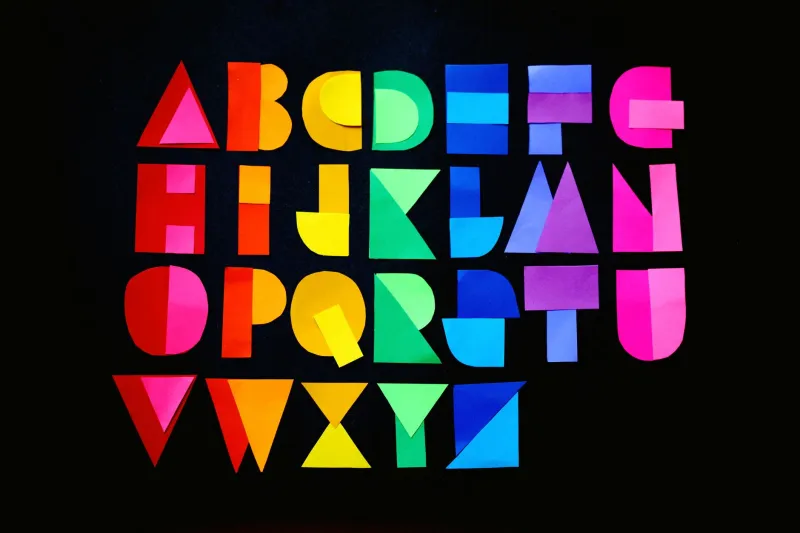
The Alphabet, One Tube at a Time
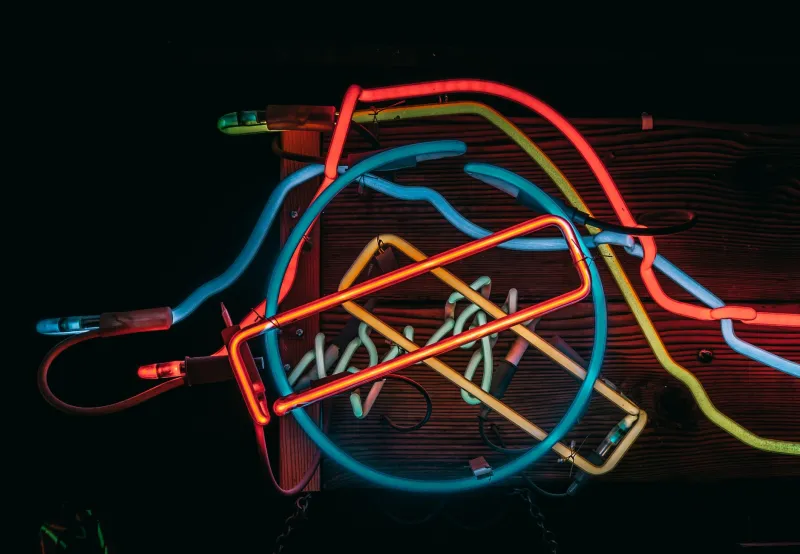
Here is what most people don't know about neon: it isn't really about the light. It's about the letter. The glass tube is simply the medium. The craft is in how you convince a straight piece of borosilicate glass, heated to around 1,200 degrees Fahrenheit, to become a curve, a corner, a loop — to become, against all physical logic, an ampersand.
Each letterform demands a different sequence of bends, a different relationship with the flame. Rounded letters like 'O,' 'C,' and 'G' require long, gradual heating across the tube's length. Angular letters — 'K,' 'Z,' 'W' — require sharp, localized bends that, if rushed even slightly, collapse the tube's interior and ruin the gas channel entirely. The whole letter dies. You start over.
This is why, in the golden age of American neon — roughly 1920 through 1970 — the craftspeople who did this work were called "benders," a title that sounds vaguely like a superpower, which is appropriate, because what they were doing was essentially bending the alphabet into a new dimension.
At its peak, the United States had over 2,000 neon shops. Today, reliable estimates put the number of working hand-benders — people who actually shape the glass themselves rather than outsourcing to automated LED approximations — somewhere between 200 and 350 nationally. Some researchers think even that figure is generous.
New Orleans: Where the Letter 'N' Never Sleeps
Down in New Orleans, a woman named Celeste Arceneaux operates out of a converted garage in the Bywater neighborhood that she describes, with complete sincerity, as "a laboratory for the alphabet."
Celeste came to neon sideways — she spent a decade as a ceramics artist before a broken sign outside a Tremé restaurant sent her down a YouTube rabbit hole that eventually led to a six-month apprenticeship in Houston and, ultimately, to her own bending table. She now produces custom signs for local bars, restaurants, and the occasional wedding backdrop, but her real obsession is letterform.
"I think about each letter as a sculpture that happens to also be a word," she says, holding a completed lowercase 'n' up to the light filtering through her garage window. The tube glows faintly even without gas, catching the afternoon sun in a way that makes it look almost biological. "When you bend a letter, you're making a decision about how that letter lives in space. Does the curve tighten here or ease off? Does the crossbar sit high or low? Every choice changes how the word feels."
Celeste is 38, which makes her something of a prodigy in a trade whose average practitioner is significantly older. She's also one of a small but growing number of younger artisans who came to neon not through family lineage but through genuine aesthetic hunger — people who looked at a street full of LED channel letters and thought, with some urgency, this is not the same thing at all.
She's correct. It isn't.
What LED Stole (Besides the Jobs)
Let's be precise about what we mean when we talk about neon dying. The glow didn't disappear. American streets are, if anything, more illuminated than ever. What disappeared was the specificity — the slight irregularity in a hand-bent curve, the way two identical letters in a single word will differ from each other by fractions of a millimeter because a human being made them, and human beings are not machines.
LED signage is uniform. It is also cheaper, safer, more energy-efficient, and significantly easier to produce at scale. Nobody serious is arguing that the economics favor neon. But there is a quality that hand-bent glass possesses that no LED matrix has yet replicated: the sense that the letter was made by someone, that it carries the trace of a decision, a breath held at the moment of the bend.
Marco Deluca puts it more bluntly: "LED signs look like a computer made them. Because a computer made them. There's nothing wrong with that. But it's not the same as this." He gestures at the wall behind him, lined with completed letters in various stages of finishing — an 'R' waiting for electrodes, a looping script 'e' cooling on a rack, a monumental 'A' that will eventually anchor the sign for a new steakhouse on the North Side. "This is handwriting. LED is typing."
The Breath Inside the Letter
There is one step in neon fabrication that almost no one outside the trade knows about, and it is the detail that lodges itself in your brain and refuses to leave.
Once a letter has been bent and the electrodes attached, the tube must be evacuated — the air pumped out — and then filled with gas. Neon, argon, sometimes a mixture. But before the gas goes in, the glassworker must "bombard" the tube: running a high-voltage current through it while it's still under vacuum, which burns off any impurities clinging to the interior walls. The tube heats from the inside. It glows in colors that don't correspond to any gas — strange purples and browns, the colors of something being cleansed.
Benders call this, with characteristic understatement, "processing." But what they are doing, in a very literal sense, is preparing the letter to hold light. They are making it ready.
Celeste Arceneaux pauses when asked about this step. "It's the part I love most," she says. "Because the letter isn't finished yet, but it's already alive. It's already doing something. You're watching it become itself."
After the Last Bend
Marco Deluca has one apprentice — his niece, Valentina, who is 24 and studying the trade with a seriousness that gives him, he admits, significant relief. Celeste Arceneaux teaches workshops twice a year and maintains a waitlist. Across the country, a handful of community colleges and art schools have begun offering neon fabrication courses, drawing students who arrive with the specific energy of people who have decided to learn something before it disappears.
This is not nothing. But it is also not sufficient to reverse a structural decline driven by economics, liability concerns (neon runs on high voltage; insurance companies are not fans), and the sheer convenience of ordering a sign from a screen.
What remains, for now, is this: somewhere in Chicago, a letter 'S' is humming above a diner. Somewhere in New Orleans, a lowercase 'n' is cooling on a rack in a garage that smells like flux. And in a few hundred shops across the country — fewer every year — someone is holding a glass tube over a flame, waiting for the moment it softens, negotiating with the material, preparing to make a letter that will outlive the conversation we're having about whether anyone will still know how to make it.
The alphabet, it turns out, is not just something you read. Sometimes, it's something you bend.