No Cap, No Comma, No Rules: The Grammar Coup Nobody Asked For (But Everyone's Typing)
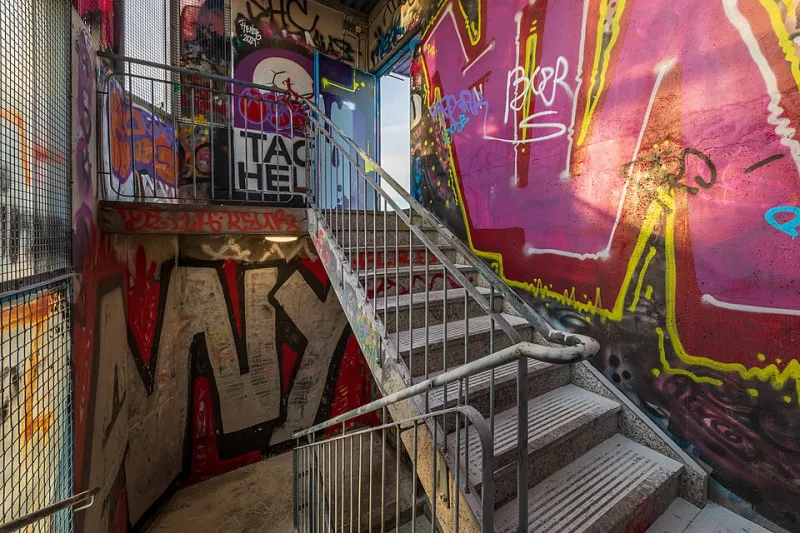
Photo: Ximonic (Simo Räsänen), CC BY 4.0, via Wikimedia Commons
Somewhere between a TikTok comment section and a Discord server dedicated to a niche anime fandom, the English sentence quietly had a breakdown. Not the sad kind. The liberating kind. The kind where it loosened its tie, kicked off its Oxford comma, and started doing something genuinely weird and interesting.
Welcome to the emoji rebellion. It doesn't have a manifesto. It doesn't need one. The manifesto would probably just be a single ☠️ followed by three dots and then nothing.
The Alphabet Had It Coming
Here at ABCDF∞, we've always maintained that the alphabet is more of a suggestion than a law. Twenty-six letters arranged in a sequence that nobody alive actually voted on, enforced by institutions that also gave us the five-paragraph essay and the passive voice. Gen Z, largely unbothered by this legacy, has been quietly—and very publicly—dismantling it.
The tools of this dismantling are everywhere once you know where to look. Lowercase as a vibe. Capitalization deployed for EMPHASIS in ways that would give an AP English teacher a migraine. Ellipses that trail off not because a thought is unfinished but because the ellipsis is the thought. The period, once neutral, now reads as aggressive. End a text with a period and your friend will call to check if you're mad at them.
This isn't sloppiness. This is syntax as performance art.
Punctuation Is Now Emotional Data
Linguists have a term for what's happening: paralinguistic reappropriation. The rest of us call it "the way my little cousin texts." But the phenomenon is real and it's sophisticated in ways that traditional grammar frameworks genuinely aren't equipped to measure.
Consider the comma. In formal writing, commas separate clauses. In a Gen Z group chat, a comma can signal hesitation, sarcasm, or the kind of loaded pause that precedes a devastating observation. "oh," sent alone as a response is not a fragment. It's a complete emotional statement. It contains multitudes. It might contain more information than a paragraph of properly structured prose.
Emojis function as a separate layer of meaning running parallel to the words—not replacing them, but annotating them in real time. "I'm fine 🙂" means something categorically different from "I'm fine 😊" which means something entirely different from "I'm fine" with no emoji at all, which means the situation is dire and you should probably call.
This is a new grammar. It has rules. They're just not written down anywhere your English teacher would recognize.
Discord Servers Are the New Literary Journals
If you want to watch living language evolve in real time, Discord is doing more interesting work than most MFA programs. Inside servers built around gaming, fan fiction, mental health support, and extremely specific meme formats, users have developed entire micro-dialects with their own vocabulary, cadence, and internal logic.
The creative writing happening in these spaces—and yes, it is creative writing—treats the traditional alphabet as a starting point rather than a ceiling. Words get stretched ("noooooo" is not the same word as "no"), fragmented ("i can't. i literally can't."), or replaced wholesale by images, GIFs, or sounds rendered in text form ("SCREAMING" as a reaction, not a description).
TikTok captions operate on their own frequency entirely. The character limit creates a kind of haiku pressure. Meaning gets compressed. Context gets assumed. The result is a form of writing that rewards fluency in the culture and actively resists outsiders who haven't done the reading. Which, if you think about it, is exactly what literary movements have always done.
The Critics Are Missing the Point (As Critics Do)
The pearl-clutching over Gen Z communication isn't new. Every generation gets accused of destroying language. The Boomers were going to kill it with slang. Millennials were going to kill it with abbreviations (lol, brb, omg—all of which are now in the dictionary, thank you very much). Gen Z is simply the latest group to be handed the bill for English's supposed demise.
But here's what the critics consistently miss: language isn't a museum exhibit. It's a living system that changes because people need it to do new things. When your primary mode of communication is text on a small screen, stripped of tone and facial expression and body language, you develop new tools to carry that missing information. You don't destroy the alphabet. You extend it.
The emoji, the creative capitalization, the strategic deployment of the ellipsis—these are solutions to a genuine communication problem. They're also, incidentally, kind of brilliant.
What the Alphabet Looks Like From Here
At ABCDF∞, we exist in that gap between the last letter anyone agreed on and the infinite possibility that comes after. Which makes Gen Z's approach to language feel less like rebellion and more like homecoming.
They didn't wait for permission to add letters to the alphabet. They just started using the ones they needed. The ☠️ where a period should be. The lowercase "i" that refuses to capitalize itself because why should it. The "<3" that predates emoji and somehow still hits differently than any heart the Unicode Consortium ever officially approved.
This is what creative resistance looks like when it happens at scale, in real time, across millions of simultaneous conversations. It's not organized. It doesn't have a leader. It doesn't need institutional validation.
It just keeps typing, lowercase, no punctuation, and somehow you understand every word.
wild, right.☠️